Intellectual property
Introduction
What is property?
What gives you property of something? posession, effort invested, first come, closeness...
What does owning something means? you can use it as you like, you can control how others use it (or don't) you can give it to someone else, you can interchange it...
Nowadays you can say in most cases that you own your body and the product of the work it does. This hasn't been always like that and in some places it's not yet real.
Ownership is relative, for example, if you own a piece of land, do you own all the sky on top of it? and what about everything thats under your land?
If you grow food on someone elses land, who owns it?
Property is a social enginering tool, it has a lot of influence on how people behave, work and live, historically it has been defined by social agreements or impositions by force. During history, the relation between ownership rules and power has been a very close one, wars and violence have defined most of the rules that end up being adopted by society.
The important part here is that the way we understand ownership has changed over time and it's definition varies depending on a lot of social, cultural and political factors defined by humans themselves.
How we understand and use property has a big impact in social relations and in general in everyone's quality of life.
What is intellectual property?
Today, in most places, in theory, physical things produced with your effort are yours, you can sell them and control how others have access to them.
We can say that intellectual property regulates the ownership of the non tangible things you produce, like a song, a story, an idea...
There is a big difference between traditional ownership of physical things and intellectual ownership, the posibility of replicating intellectual work, in most cases with no effort involved, presents a complete different paradigm.
When you sell an intellectual product you don't loose your possession, you just give a "copy" and keep yours. Scarcity does not play a roll in this operation, unless we artificially introduce it.
The concept of intellectual property can be used to generate scarcity in non tangible goods so they can behave similarly to physical things, and allow traditional forms of interchange to be applied.
The capacity of replicating goods (with low or no cost) opens new ways of understanding ownership that were not possible before, bringing to the table different posibilities to improve individual and collective wellness.
Intellectual goods have a really big impact in today societies and economies, the rules we use to regulate its ownership will shape and define how we will work and live in the future.
Different IP models

This is a comparison of different IP Models. From All Rights Retained to All Rights Relinquished.
- In Wikipedia
- Selector by EU Commision
- And more guides about it here and here
Patent

A patent is a form of intellectual property that gives its owner the legal right to exclude others from making, using, selling, and importing a (new?), unique and useful invention, discovery or process for a limited period of years, in exchange for publishing an enabling public disclosure of the invention. In most countries patent rights fall under civil law and the patent holder needs to sue someone infringing the patent in order to enforce his or her rights. In some industries patents are an essential form of competitive advantage; in others they are irrelevant.
A patent, being an exclusionary right, does not necessarily give the patent owner the right to exploit the invention subject to the patent. For example, many inventions are improvements of prior inventions that may still be covered by someone else's patent. If an inventor obtains a patent on improvements to an existing invention which is still under patent, they can only legally use the improved invention if the patent holder of the original invention gives permission, which they may refuse.
The patent is valid for a duration of typically 20 years.
Copyright

Copyright grants to creators a bundle of exclusive rights over their creative works, which generally include, at a minimum, the right to reproduce, distribute, display, and make adaptations. The phrase “All Rights Reserved” is often used by owners to indicate that they reserve all of the rights granted to them under the law. When copyright expires, the work enters the public domain, and the rights holder can no longer stop others from engaging in those activities under copyright, with the exception of moral rights reserved to creators in some jurisdictions.
The copyright is valid, in general during the life of the author/creator, plus 70 years. For works made for hire (works created for a business under a contract that gives the business the copyright): 95 years from publication or 120 years from creation, whichever is shorter.
Open source
Open source licenses are licenses that comply with the Open Source Definition — in brief, they allow software to be freely used, modified, and shared. To be approved by the Open Source Initiative (also known as the OSI), a license must go through the Open Source Initiative's license review process.
This is probably the shortest definition of them all, but this is what the content below is about!
Find the licenses here: https://opensource.org/licenses
The default case
When you make a creative work (such as writing, graphics, or code), that work is under exclusive copyright by default. That is, the law assumes that as the author of your work, you have a say in what others can do with it.
In general, that means nobody else can use, copy, distribute, or modify your work without being at risk of take-downs, shake-downs, or litigation. Open source is an unusual circumstance, however, because the author expects that others will use, modify, and share the work. But because the legal default is still exclusive copyright, you need a license that explicitly states these permissions.
Making your Git project public is not the same as licensing your project.
The Creative Commons Case
Creative Commons is a project that tries to simplify the way Intellectual Property licenses are chosen. It provides a simple set of rules for choosing a license, but it doesn't mean that they are open source as defined by the open source definition. You can find them here.

Public Domain

The public domain (PD) consists of all the creative work to which no exclusive intellectual property rights apply. Those rights may have expired, been forfeited, expressly waived, or may be inapplicable. Because no one holds the exclusive rights, anyone can legally use or reference those works without permission.
Examples
- "Do What The Fuck You Want To Public License" (WTFPL)
- Creative Commons Zero
- Unlicense
Software Licensing Models
For the specific case of software is as follows:
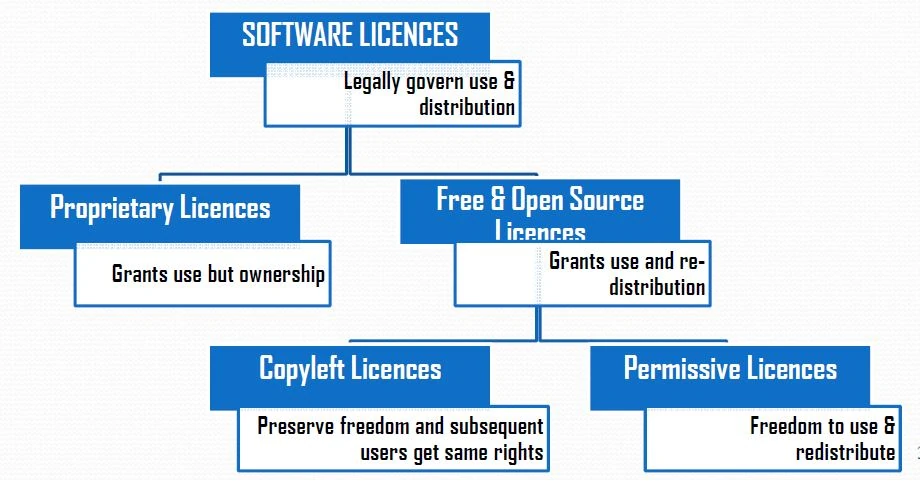
Copyleft Licenses
GNU Licenses: GPL and LGPL
Free Software Foundation: Free as in freedom


Nobody should be restricted by the software they use. There are four freedoms that every user should have:
- the freedom to use the software for any purpose,
- the freedom to change the software to suit your needs,
- the freedom to share the software with your friends and neighbors, and
- the freedom to share the changes you make.
When a program offers users all of these freedoms, we call it free software.
GPL
Free software license by the Free Sofwware Foundation, which guarantees end users the freedom to run, study, share and modify the software.
Examples of GNU GPL Project:
- Linux Kernel
- GCC
👏 100% of Supercomputers in the world are running Linux
LGPL
The GNU Lesser General Public License is a free software license published by the Free Software Foundation. The license allows developers and companies to use and integrate software released under the LGPL into their own software without being required by the terms of a strong copyleft license to release the source code of their own components.
When to use it? when there is no advantage for the software released to use this library, i.e. when the functionalities it gives are already available through other libraries.
Mozilla Public License (MPL)
It is a weak copyleft license, characterized as a middle ground between permissive free software licenses and the GNU General Public License (GPL), that seeks to balance the concerns of proprietary and open source developers.
Examples
- LibreOffice
Permissive Licenses
Unlike both copyleft licenses and copyright law, permissive free-software licenses do not control the license terms that a derivative work falls under. Copyleft says that anyone who redistributes the software, with or without changes, must pass along the freedom to further copy and change it. Permissive licenses, however, have created a lot of controversy, and in particular have conflicted with some copyleft licenses, the argumentation being the control someone has over the rights of the derivative works.
BSD License
BSD licenses are a family of permissive free software licenses, imposing minimal restrictions on the use and distribution of covered software. This is in contrast to copyleft licenses, which have share-alike requirements. The original BSD license was used for its namesake, the Berkeley Software Distribution (BSD), a Unix-like operating system. The original version has since been revised, and its descendants are referred to as modified BSD licenses.
MIT License
Permissive Free Sofware license that permits reuse within proprietary software provided that all copies of the licensed software include a copy of the MIT License terms and the copyright notice. The MIT license is also compatible with many copyleft licenses, such as the GNU General Public License (GPL); MIT licensed software can be integrated into GPL software, but not the other way around.
Like the BSD license the MIT license does not include an express patent license. Both the BSD and the MIT licenses were drafted before the patentability of software was generally recognized under US law.
Hardware Licensing Models
In addition to the models indicated above (Patents, Public Domain, etc.), there is a model in which you can create hardware and release as open source.
Open source hardware is hardware whose design is made publicly available so that anyone can study, modify, distribute, make, and sell the design or hardware based on that design. The hardware's source, the design from which it is made, is available in the preferred format for making modifications to it.
Ideally, open source hardware uses readily-available components and materials, standard processes, open infrastructure, unrestricted content, and open-source design tools to maximize the ability of individuals to make and use hardware. Open source hardware gives people the freedom to control their technology while sharing knowledge and encouraging commerce through the open exchange of designs.
- Open Source Hardware
- Free Hardware designs
- CERN Open Hardware License Project
- Projects using the CERN Open Hardware Licence
Historic example: Reprap Project vs Makerbot
Readings
This compilation has a lot of articles related to intellectual property; it is not intended as a list to be read in one shot, but a general repository to keep memory of interesting readings found through the years.
Opinion
🌐 MALUS
Finally, liberation from open source license obligations.
Our proprietary AI robots independently recreate any open source project from scratch. The result? Legally distinct code with corporate-friendly licensing. No attribution. No copyleft. No problems.
🌐 Did You Say “Intellectual Property”? It's a Seductive Mirage
It has become fashionable to toss copyright, patents, and trademarks—three separate and different entities involving three separate and different sets of laws—plus a dozen other laws into one pot and call it “intellectual property.”
🌐 Why "non-commercial" is a "non-good" idea for your project
A surprising large number of projects and people are not aware that by labeling their project "Creative Commons NonCommercial" they are taking it out of the Open Source pool and also likely keeping their project from being useful to people.
🌐 Sustainable creativity in a world without copyright
Everyone reading this post has grown up in a creative world defined by capitalism, in which adapting and remixing works — a fundamental part of the creative process — is illegal. The commons is dead, and we suffer for it. But, this is all we’ve ever known. It can be difficult to imagine a world without copyright.
🌐 Toward Copyleft Equality for All
As the popularity of Open Source has grown, companies have searched for methods to combine traditional proprietary licensing business models with FOSS offerings.
🌐 Open Design. It is the way
Making the information about how a product works and how it is manufactured available to everyone is called Open Design; it encompasses both Open Hardware and Open Source Software.
🌐 Makerbot, Occupy Thingiverse, And The Reality Of Selling Open Hardware
The new Replicator 2 is rumored to be closed source. If that’s not enough, [Bre Pettis], co-founder and CEO of Makerbot Industries will be speaking at the Open Source Hardware Association conference next week with the suitably titled talk, “Challenges of Open Source Consumer Products.”
🌐 The state of open-source in 3D printing in 2023
During the last decade, I have always been against companies that have turned away from the open-source community as time went by, eventually becoming closed-source. I don’t want Prusa Research to go in the same direction.
Some reply's to Prusa's blog post: A reply to Josef Průša and A(nother) Reply to Josef Průša
🌐 With Core ONE, Prusa’s Open Source Hardware Dream Quietly Dies
With the Core ONE, Prusa Research is no longer in the business of making open source 3D printer hardware...
🌐 When Open Becomes Opaque: The Changing Face of Open-Source Hardware Companies
...recently some open-source hardware companies have either gone closed-source on products, are in process of going closed-source, are delaying the release of files/source code...
🌐 What Does an Open Source Hardware Company Owe The Community When it Walks Away?
This week Prusa Research, once one of the most prominent commercial members of the open source hardware community, announced its latest 3D printer. The printer is decidedly not open source.
Guides / compilations / selector tools
🌐 Write Free Software site
🌐 Understanding legal implications of open source
🌐 License Selector by EU Commision
Legal / cases
🌐 Brute-Forced Copyrighting: Liberating all the melodies
...musician tech guy with a law degree [Damien Riehl] and musician software developer [Noah Rubin] got together to simply create every possible melody as MIDI files, releasing them under the Creative Commons Zero license.
🌐 Are Patent Claims Coming For Your WS2812?
US patent number 8094102B2 is indeed a patent for a “Single full-color LED with driving mechanism”, which does look a lot like a WS2812.
🌐 Multimeters without a country: Flukes broad trademark bans yellow multimeter imports.
SparkFun is forced to incinerate 2,000 multimeters because they are yellow.
🌐 Copyright infringement in artificial intelligence art
As AI creative tools are becoming widespread, the question of copyright of AI creations has also taken centre-stage. But while copyright nerds obsess over the authorship question, the issue that is getting more attention from artists is that of copyright infringement.
🌐 GitHub Copilot and open source laundering
In the process, they (github) built a tool which facilitates the large-scale laundering of free software into non-free software by their customers, who GitHub offers plausible deniability through an inscrutable algorithm.
You can do what github does with open source code but with music: Launder your copyrighted music here!
🌐 Github Copilot Investigation
Maybe you don’t mind if GitHub Copilot used your open-source code without asking. But how will you feel if Copilot erases your open-source community?
🌐 Everything a government attorney needs to know about open source software licensing
A high-level overview to highlight common legal issues government agencies may face when participating in the open source community
🌐 The Github youtube-dl Takedown Isn't Just a Problem of American Law The video downloading utility youtube-dl, like other large open source projects, accepts contributions from all around the globe. It is used practically wherever there's an Internet connection.
Information
🌐 Multi-licensing wikipedia article
🌐 Microsoft repo installed on all Raspberry Pi’s
🌐 Idea - Expression of idea Distinction
🌐 Open Source Initiative - The Open source definition
🌐 Open Source Hardware Definition (OSHW)
Web Sites
The Free Software Foundation (FSF) is a nonprofit with a worldwide mission to promote computer user freedom. We defend the rights of all software users. ...
GNU is an operating system that is free software—that is, it respects users' freedom. ...
CC is an international nonprofit organization that empowers people to grow and sustain the thriving commons of shared knowledge and culture ...
Why is software created using taxpayers’ money not released as Free Software? ...
Books
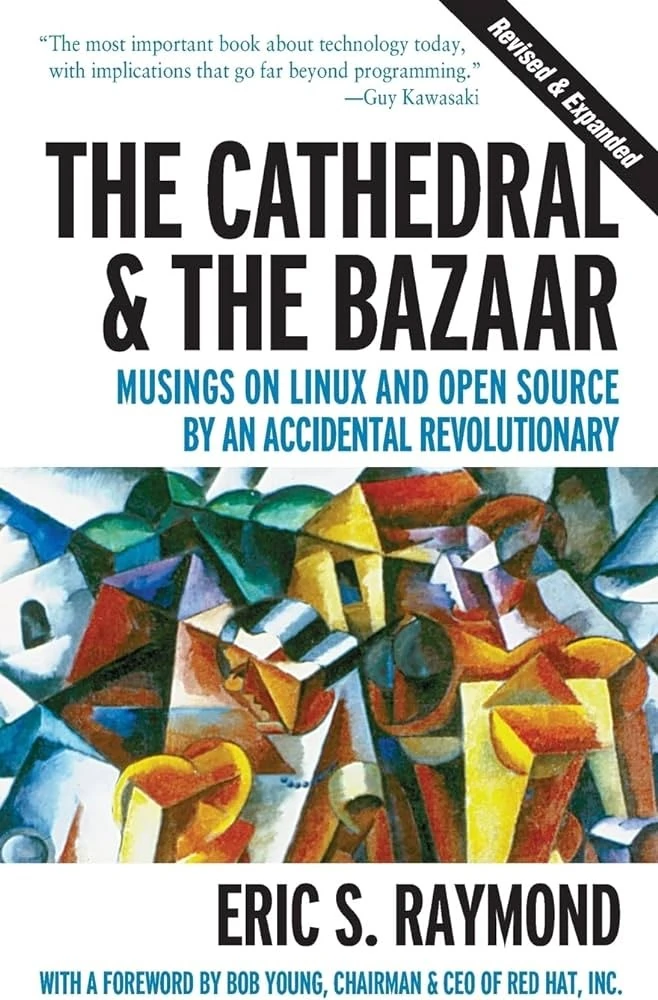
📚 The Cathedral & the Bazaar
Musings on Linux and Open Source by an Accidental Revolutionary
Eric S. Raymond, 1999
Open source provides the competitive advantage in the Internet Age. According to the August Forrester Report, 56 percent of IT managers interviewed at Global 2,500 companies are already using some type of open source software in their infrastructure and another 6 percent will install it in the next two years. This revolutionary model for collaborative software development is being embraced and studied by many of the biggest players in the high-tech industry...
You can find the full book here (spanish).
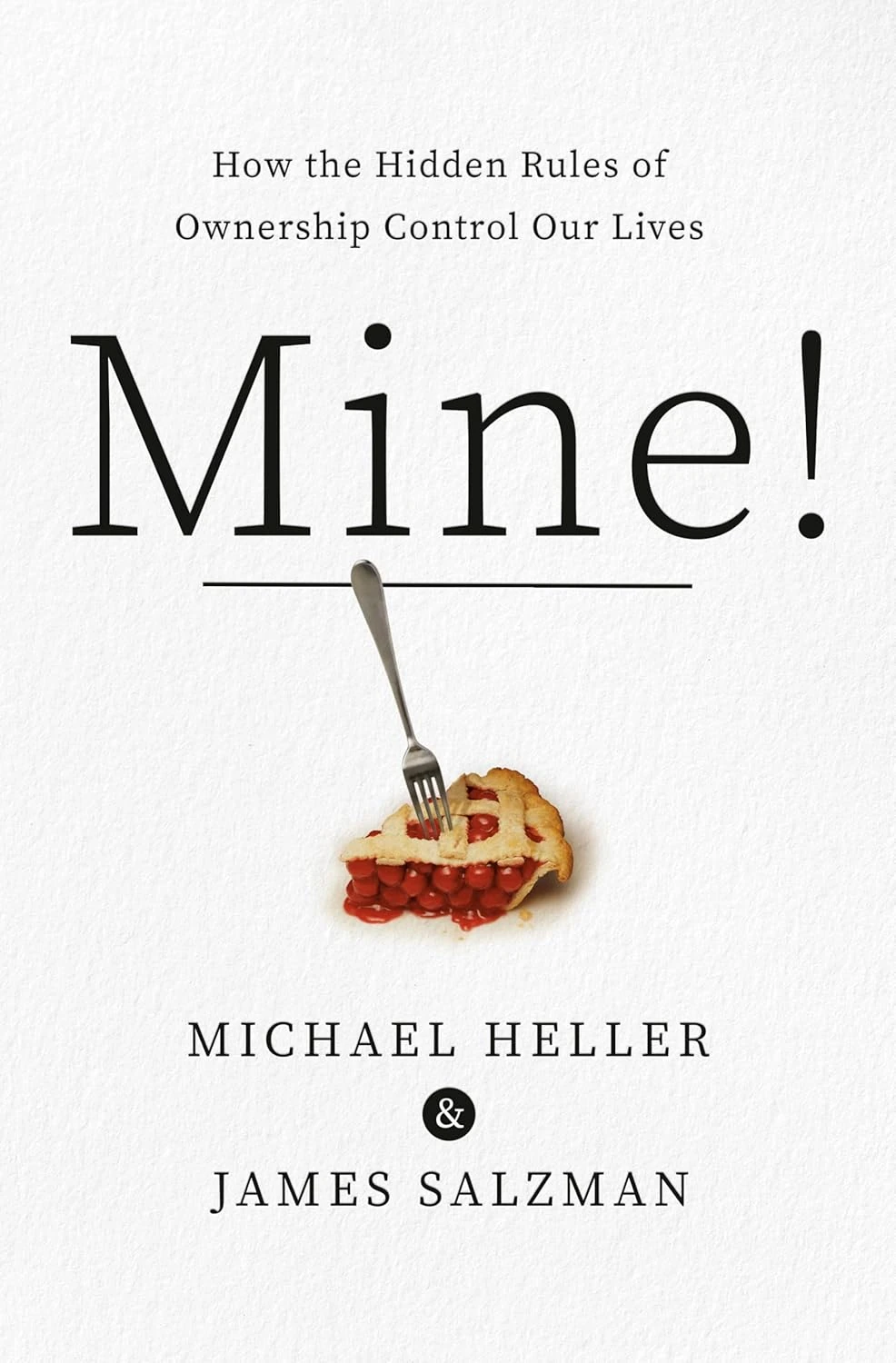
📚 Mine!
How the Hidden Rules of Ownership Control Our Lives
Michael A. Heller and James Salzman, 2018
“Mine” is one of the first words babies learn, and by the time we grow up, the idea of ownership seems natural, whether we are buying a cup of coffee or a house. But who controls the space behind your airplane seat: you, reclining, or the squished laptop user behind you? Why is plagiarism wrong, but it’s okay to knock off a recipe or a dress design? And after a snowstorm, why does a chair in the street hold your parking space in Chicago, while in New York you lose both the space and the chair?
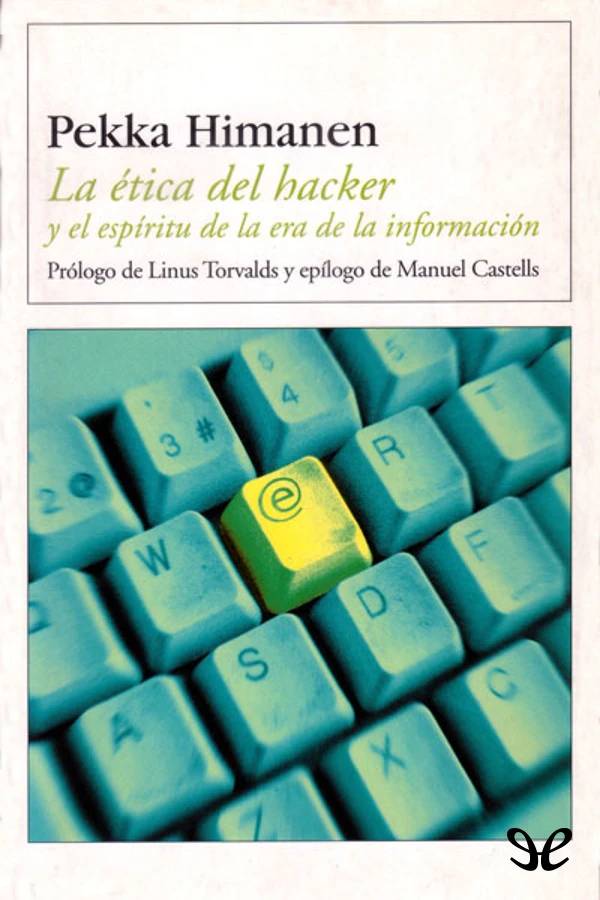
📚 The Hacker Ethic
and the spirit of the Information Age
Pekka Himanen, 2000
At the center of our technological age are people who call themselves hackers. They define themselves as people who engage in passionate programming and believe that it is a duty for them to share information and develop free software... This book is an invitation to visit the fundamental issues about life in the information society, to take a journey full of surprises that will help us to direct our lives to new and exciting perspectives.
You can find the full book here (spanish).